
Prediction Market Fee Calculator
See how platform fees affect your expected value. Compare Polymarket and Kalshi fee structures to find out what you're really paying.
Fee Calculator
Entry price
Your true probability
You'd make $0.040 per share.
How Prediction Market Fees Work
Every prediction market charges fees, but the structures vary. Fees might seem small (a few cents per share here, a fraction of a percent there) but they shift your breakeven probability and eat into your edge. A bet that looks +EV before fees might actually be -EV after them. For the full breakdown, read how prediction market fees eat your edge.
Polymarket Fees
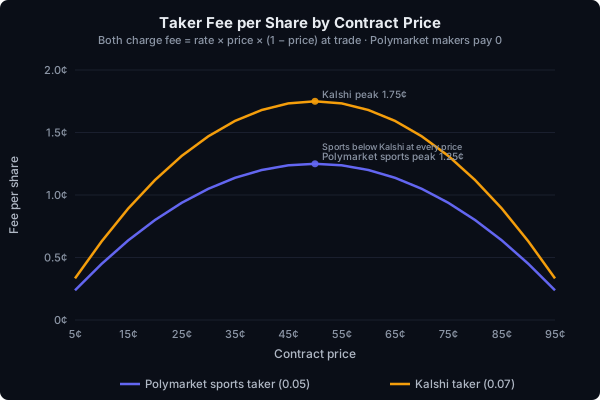
Polymarket charges takers a per-category fee: shares × rate × price × (1 − price). The rate is 0.04 on politics and finance, 0.05 on sports, and 0.07 on crypto. The curve peaks at 50¢ and falls toward the extremes, the same shape as Kalshi's fee. Example: 100 sports shares at 50¢ cost 100 × 0.05 × 0.5 × 0.5 = $1.25. The same 100 shares at 90¢ cost 100 × 0.05 × 0.9 × 0.1 = $0.45. Makers who post resting limit orders pay 0 and earn a rebate on the taker fees they fill against.
Kalshi Fees
Kalshi uses a formula-based fee charged when you place the trade (not at resolution). The taker fee is 7% × price × (1 − price) per contract. This creates a curve where 50/50 markets have the highest fee (~1.75¢ per contract) and extreme-odds markets have almost no fee. Maker orders (limit orders that provide liquidity) pay roughly 4x less.
Why Fees Matter More Than You Think
The real cost of fees isn't the dollar amount. It's how they shift your breakeven probability. Without fees, a 60¢ contract needs a 60% true probability to break even. Both platforms charge the fee at trade, so it pushes the breakeven up by the fee itself. On Polymarket sports (0.05) the fee at 60¢ is 1.2¢, moving breakeven to about 61.2%. On Kalshi (0.07) the fee is 1.68¢, moving it to about 61.7%. A Polymarket maker pays 0 and stays at 60%. That shift can turn a marginal +EV bet into a losing one. See the exact breakeven shift for any contract price with our Break-Even Calculator.
Worked Example
You buy 100 shares of “Yes” at 55¢ on Kalshi as a taker. Fee per share: 7% × 0.55 × 0.45 = 1.73¢. Total fee: $1.73. Total cost: $56.73 (vs. $55.00 without fees). If the contract resolves Yes, you receive $100, a profit of $43.27 instead of $45.00. The same trade on Polymarket sports (0.05) is charged at trade: 100 × 0.05 × 0.55 × 0.45 = $1.24. Total cost: $56.24. If it resolves Yes, profit is $43.76 instead of $45.00, so Polymarket costs $0.49 less than Kalshi per 100 shares. On politics and finance (0.04) the fee drops to $0.99 and the gap widens. A Polymarket maker pays 0. The ranking holds at every price: sports and politics stay below Kalshi, crypto matches it at 0.07.
Platform Fee Comparison
| Platform | Fee Structure | When Charged |
|---|---|---|
| Polymarket Taker | 4-5% × p × (1-p), crypto 7% | At trade execution |
| Polymarket Maker | 0 (earns rebate) | At trade execution |
| Kalshi Taker | 7% × p × (1-p) | At trade execution |
| Kalshi Maker | 1.75% × p × (1-p) | At trade execution |
Common Questions
Which platform has lower fees?
Both platforms use the same per-price formula: fee = shares × rate × price × (1 − price), which peaks at 50¢ and shrinks toward the extremes. The difference is the rate. Polymarket charges 0.04 on politics and finance and 0.05 on sports, both under Kalshi's 0.07, so Polymarket is cheaper on those markets. On crypto both sit at 0.07 and match. Polymarket makers who post limit orders pay 0, the cheapest option on any market.
Do fees apply if I sell my position before resolution?
Yes, on both platforms. The taker fee is charged on every trade at execution, so selling a position triggers it the same as buying. On Polymarket you pay 0 as a maker by posting a limit order instead of taking the market price. Trading in and out also carries a spread cost.
What's the difference between maker and taker on Kalshi?
A taker is someone who buys at the current asking price (market order). A maker places a limit order that waits to be filled. Makers get lower fees because they provide liquidity to the market. Most casual users are takers.
Should I factor fees into every trade?
Yes. Even small fees compound over time. If you're making 100 trades and each one has 2% less EV than you thought, that's a significant drag on your returns. This calculator helps you see the true EV before you click buy.
What about Robinhood and other new prediction market platforms?
Robinhood, Coinbase, and other platforms entering prediction markets each have their own fee structures. Robinhood has announced commission-free prediction market trading (similar to their stock trading model). As new platforms launch, compare their fees here using the custom fee option. Even 'free' platforms may have wider spreads that function like hidden fees.
How do prediction market fees compare to sportsbook vig?
Prediction market fees are generally lower than sportsbook vig. A standard -110/-110 sportsbook line has about 4.5% total margin. Polymarket's per-category taker fee (0.04-0.05 on most markets) and Kalshi's formula-based fee typically amount to 1-3% total cost. This lower 'tax' is one reason prediction markets are attractive to quantitative traders. Less edge is lost to the platform.