
Prediction Market Calculator
A free calculator for Kalshi, Polymarket, and any event contract. Enter a contract price, your probability estimate, and your stake to see your expected value, edge, and optimal Kelly bet size after platform fees.
Expected Value Calculator
Contract price
Your probability
Stake
Bankroll
Expected to make $6.63 on $100
Kelly Criterion
Expected Value in Prediction Markets
Expected value (EV) is the average amount you'd make per trade over many repetitions. If a contract trades at 60 cents and you believe the true probability is 65%, your EV before fees is 5 cents per share. After fees, it's less, but this tool shows you exactly how much less and whether the trade is still worth making.
How This Differs from Sports Betting EV
In sports betting, you compare a rec book's odds against a de-vigged sharp line. The sharp book gives you your “true probability.” In prediction markets, there's no sharp book to reference. You need to bring your own probability estimate from your research, models, or domain expertise. This makes prediction market EV both more accessible (anyone can trade) and more challenging (your edge depends entirely on the quality of your estimate).
The other key difference is fees. Sports bettors pay the vig embedded in the odds. Prediction market traders pay platform-specific fees that vary by platform and contract price. This calculator accounts for those fees so you see your true net EV, the number that actually determines whether a trade is profitable.
How to Use This Calculator
- Enter the current contract price (e.g., 60¢)
- Enter your estimated true probability (e.g., 68%)
- Enter your stake (how much you plan to invest)
- Select your platform for accurate fee calculation
- See your EV, edge percentage, and Kelly-optimal position size
Worked Example
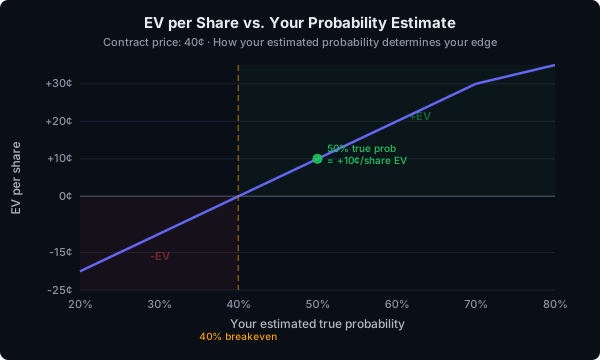
“Will Company X report earnings above $2.50 EPS?” trades at 40¢ on Polymarket. Your analysis of the company's guidance, analyst consensus, and sector trends puts the true probability at 50%. That's a 10% edge before fees. Polymarket charges takers a per-category fee of shares × feeRate × p × (1 − p), where p is the price in dollars. This is a finance market, so the feeRate is 0.04. At the 40¢ price the taker fee is 0.04 × 0.40 × 0.60 = 0.96¢ per share, charged at the trade regardless of outcome. Your net EV per share: (0.50 × 60¢) − (0.50 × 40¢) − 0.96¢ = 30¢ − 20¢ − 0.96¢ = 9.04¢ per share. On a $200 stake (500 shares), that's about $45 expected profit. Makers pay 0 and earn a rebate. Kelly says the optimal stake at 1/4 Kelly with a $5,000 bankroll would be about $300.
Common Questions
What is Kelly Criterion?
Kelly Criterion tells you the mathematically optimal fraction of your bankroll to risk on a bet given your edge. Full Kelly maximizes long-term growth but is volatile. Most traders use 1/4 or 1/2 Kelly for smoother results.
Why does Kelly sometimes say to bet more than my stake?
Kelly tells you the optimal size. If it suggests more than you planned to bet, it means your edge is large relative to your bankroll. But Kelly assumes your probability estimate is exactly right. In practice, use fractional Kelly to account for uncertainty.
How do I estimate my true probability?
That's the hard part. Use base rates, domain expertise, inside information (legal in prediction markets), model outputs, or consensus from sharp traders. The accuracy of your probability estimate is more important than any calculator.
How is prediction market EV different from sports betting EV?
The core math is identical: EV = (probability × profit) - ((1 - probability) × loss). The difference is where you get your 'true probability.' In sports betting, you de-vig a sharp book's line. In prediction markets, you bring your own probability estimate. There's no equivalent of a Pinnacle line to de-vig. Your edge is only as good as your probability model.
What position size should I use?
Use Kelly Criterion. This calculator includes it. A common approach is 1/4 Kelly: if Kelly says to risk 20% of your bankroll, bet 5%. This accounts for the uncertainty in your probability estimate and smooths out variance dramatically while still growing your bankroll.
What EV percentage makes a trade worth it?
Any positive EV is mathematically worth taking, but in practice, most traders look for at least 2-3% EV after fees to justify the execution cost and risk. At lower EV percentages, small errors in your probability estimate can flip the trade to negative. Higher conviction = lower EV threshold.