
Break-Even Win Rate Calculator
Enter a contract price and platform to see how often you need to be right just to break even. Fees shift the threshold higher than you might think.
Break-Even Calculator
Contract price
You need to be right
61.0%
of the time to break even
Why Breakeven Matters
A contract trading at 60 cents doesn't just need a 60% chance of happening to be worth buying. Platform fees shift the breakeven probability upward. On Polymarket, a sports taker fee of 0.05 pushes a 60-cent contract's breakeven to about 61.2%. On Kalshi, taker fees can push it close to 62%. That difference matters when you're looking for edges measured in single-digit percentages.
How Platform Fees Affect Your Edge
Your “edge” on a prediction market trade is the gap between your estimated true probability and the breakeven probability, not the contract price. If you think an event has a 70% chance and the contract is at 65¢, your gross edge is 5%. But after Kalshi taker fees, the breakeven shifts from 65% to roughly 66.5%, cutting your real edge to 3.5%. On a $500 position, that's $7.50 less profit than you thought. Over hundreds of trades, ignoring fees means systematically overestimating your edge.
How to Use This Calculator
- Enter the contract price (e.g., 60¢ for a “Yes” contract)
- Select your platform: Polymarket, Kalshi Taker, Kalshi Maker, or Custom
- The calculator instantly shows your breakeven win rate after fees
- Compare that breakeven against your probability estimate to see your true edge
Worked Example
You see “Will the Fed cut rates in June?” trading at 45¢ on Kalshi. Without fees, you need a 45% true probability to break even. As a Kalshi taker, the fee is 7% × 0.45 × 0.55 = 1.73¢ per contract. Your effective cost per contract is 46.73¢, pushing breakeven to about 46.7%. If your model says 50%, your real edge is 50% - 46.7% = 3.3%, not 5%. On Polymarket as a sports taker, the fee is 0.05 × 0.45 × 0.55 = 1.24¢ per contract, pushing breakeven to about 46.2% and giving you a 3.8% edge instead.
Fee Impact Comparison by Contract Price
| Contract Price | Polymarket Sports | Kalshi Taker | Kalshi Maker |
|---|---|---|---|
| 20¢ | 20.8% | 21.1% | 20.3% |
| 35¢ | 36.1% | 36.6% | 35.4% |
| 50¢ | 51.3% | 51.8% | 50.4% |
| 65¢ | 66.1% | 66.6% | 65.4% |
| 80¢ | 80.8% | 81.1% | 80.3% |
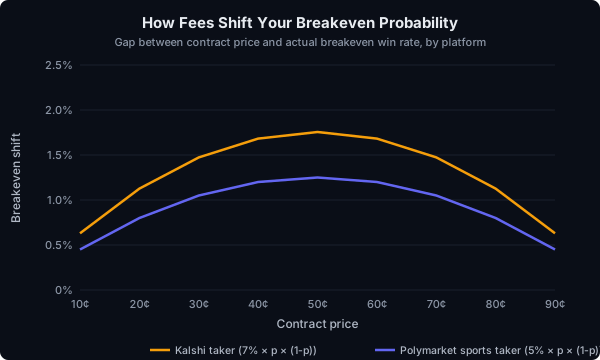
Kalshi taker fees have the biggest impact near 50¢ contracts. For extreme-odds contracts (10¢ or 90¢), the fee difference between platforms shrinks substantially. Always check the breakeven at your specific price point rather than relying on general rules. For a deeper fee breakdown, use our Prediction Market Fee Calculator. Once you know your real breakeven, check whether a trade is worth it with the Prediction Market EV Calculator.
Common Questions
Why is breakeven different from the contract price?
Because platforms charge fees. Even though you buy a contract at 60 cents and it pays $1 if you win, the fee reduces your effective payout. You need to win more often than 60% of the time to cover both the cost of the contract and the fees.
Which platform has the lowest fee impact?
Makers pay the least. Polymarket makers pay 0 and earn a rebate, and Kalshi makers pay a 0.0175 formula fee. Among takers, Polymarket politics and finance (0.04 rate) and sports (0.05 rate) sit below Kalshi and Polymarket crypto, which both use a 0.07 rate. Every fee is a parabola that peaks near the 50-cent mark and shrinks toward zero at extreme prices.
How should I use this?
Before buying any contract, check the breakeven. If you think an event has a 65% chance and the contract is at 60 cents, your edge is only 5% before fees. After fees, it might be closer to 3-4%. Know your real edge, not just the gross number.
How much does Kalshi charge in fees?
Kalshi uses a formula-based fee: 7% × price × (1 - price) for takers and about 1.75% × price × (1 - price) for makers. This means fees peak on 50/50 markets (~1.75¢ per contract for takers) and shrink toward zero for extreme-odds contracts. On a 50¢ contract, a taker pays about 1.75¢ in fees.
How much does Polymarket charge in fees?
Polymarket charges takers a formula fee: shares × feeRate × price × (1 - price), the same curve shape as Kalshi. The feeRate is 0.05 for sports, 0.07 for crypto, and 0.04 for politics and finance. Makers pay 0 and earn a rebate of 15% of collected sports taker fees, 20% crypto, and 25% for other categories. On 100 sports shares at 50¢, the taker fee is 100 × 0.05 × 0.5 × 0.5 = $1.25. At 90¢ it drops to 100 × 0.05 × 0.9 × 0.1 = $0.45. The fee is charged at the trade, not only on winners.
Do prediction market fees affect the breakeven the same at all prices?
No, but both platforms follow the same shape. Kalshi and Polymarket both charge a parabolic fee that peaks at 50¢ contracts and drops toward zero at extreme prices. Polymarket's rate is lower on most categories (0.04 to 0.05) than Kalshi's 0.07, so its curve has a smaller amplitude, except Polymarket crypto, which matches Kalshi at 0.07. At 10¢ or 90¢ contracts, both fees are very small.