
Hold Calculator
Enter the odds for any market and see how much juice the book is charging. Lower hold means better value for bettors.
Hold Calculator
The book is charging 4.8% margin on this market
Fair odds (no vig)
What Is Hold?
Hold (also called margin, overround, or vig) is how the sportsbook makes money. In a fair coin flip, both sides should be +100. Instead, books offer -110/-110. The implied probabilities sum to 104.8% instead of 100%. That extra 4.8% is the hold. It means no matter which side wins, the book keeps a cut.
Think of hold as the “tax” on every market (learn more in our complete guide to vig). The higher the hold, the more you're overpaying relative to the true odds. A book with 2% hold is charging you roughly half as much as one with 4% hold. Over hundreds or thousands of bets, that difference compounds dramatically. Sharp bettors obsess over hold because it directly determines how large their edge needs to be just to break even.
How Sportsbooks Make Money
Sportsbooks don't need to predict outcomes correctly to profit. They build a margin into every line they offer, then try to attract roughly equal action on both sides. When the book has -110 on each side of a spread, a bettor must risk $110 to win $100 regardless of which side they take. If the book gets $110 on each side ($220 total), they pay out $210 to the winner (their $110 back plus $100 profit) and keep $10. That $10 on $220 in action is a 4.5% margin, pure profit for the house, regardless of the outcome.
How to Use This Calculator
- Enter the odds for each outcome in the market (e.g., -110 and -110 for a standard spread)
- Choose your odds format: American, Decimal, or Implied Probability
- For 3-way markets (like soccer), toggle to 3-way mode and enter the draw odds too
- The calculator instantly shows the booksum (total implied probability), the hold percentage, and what fair odds would look like without the vig
Worked Example
Say DraftKings has the Chiefs at -150 and the 49ers at +130 on the moneyline. Converting to implied probability: Chiefs = 150 / (150 + 100) = 60.0%. 49ers = 100 / (130 + 100) = 43.5%. The booksum is 60.0% + 43.5% = 103.5%. That means the hold is 3.5%, relatively tight for a US retail book. Compare that to a player prop at -130/+100: that's 56.5% + 50.0% = 106.5% booksum, meaning a 6.5% hold, nearly double the margin.
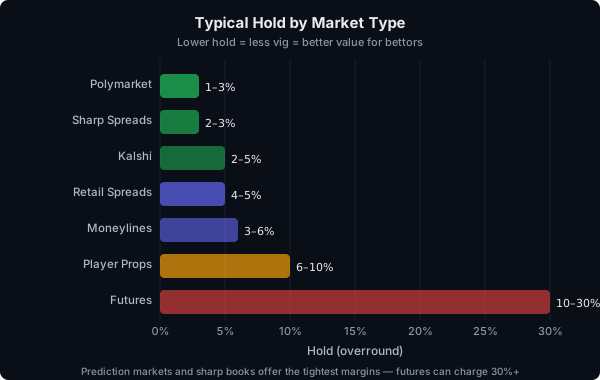
Hold Across Different Markets
| Market Type | Typical Hold |
|---|---|
| NFL/NBA Spreads (sharp books) | 2–3% |
| NFL/NBA Spreads (retail books) | 4–5% |
| Moneylines (major sports) | 3–6% |
| Player Props | 6–10% |
| Futures / Outrights | 10–30% |
| Prediction Markets (Polymarket) | 1–3% |
| Prediction Markets (Kalshi) | 2–5% |
Notice the pattern: the more liquid and efficient the market, the lower the hold. NFL spreads at Pinnacle have the tightest margins because sharp money keeps the lines honest. Player props and futures have wide margins because the books have less confidence in their lines and recreational bettors are less price-sensitive. Once you know the hold, use our De-Vig Calculator to strip the margin and find the true fair odds, then check if your bet has positive expected value with the EV Calculator.
Common Questions
What's a good hold percentage?
Sharp books like Pinnacle run 2-3% hold. Most US retail books charge 4-5% on standard markets and 6-8%+ on props and player markets. Anything under 3% is excellent value; over 7% and you're giving up a lot of edge to the book.
How does hold affect my long-term results?
Hold is a direct drag on your returns. If you're betting randomly into a 5% hold market, you'll lose about 2.5% of every dollar wagered over time. Sharp bettors seek out low-hold markets because it's easier to overcome a 2% margin than a 7% one.
Why do some markets have higher hold?
Books increase hold on markets where they have less confidence in their lines (props, futures, niche sports) and on markets where recreational bettors are less price-sensitive. Mainline NFL spreads typically have lower hold than player prop markets.
What is overround in betting?
Overround is another name for hold. It's the amount by which the implied probabilities of all outcomes exceed 100%. A market with -110 on both sides has implied probabilities of 52.38% + 52.38% = 104.76%. The overround is 4.76%. Some bettors also call this the 'booksum,' the total of all implied probabilities.
How do I calculate hold from odds?
Convert each outcome's odds to implied probability, then add them together. For American odds: negative odds use 100 / (odds + 100), positive odds use odds / (odds + 100). Add all the implied probabilities. The amount over 100% is the hold. For example, -150 and +130: 60% + 43.5% = 103.5%, so the hold is 3.5%.
What is vig in sports betting?
Vig (short for vigorish, also called juice or rake) is the commission the sportsbook charges on every bet. It's built into the odds themselves. Instead of offering true +100/+100 on a coin flip, the book offers -110/-110. That difference is the vig, and it's how the house makes money regardless of which side wins.
Is hold the same as house edge?
They're closely related but not identical. Hold is the total overround on a market (how much the implied probabilities exceed 100%). House edge is the expected percentage the house keeps per dollar wagered. For a balanced 2-way market, the house edge is roughly half the hold. A 4.8% hold translates to about a 2.4% house edge per dollar bet.