
Odds Converter
Convert between American, Decimal, Fractional odds and Implied Probability. Type into any field and the others update instantly.
Odds Converter
52.4%
When to Use This Tool
- Comparing sportsbook lines. Different books display odds in different formats. Convert everything to one format to compare prices instantly.
- Reading European or UK odds. Encountered decimal or fractional odds on an international sportsbook? Convert them to American odds (or vice versa) to understand the price.
- Checking prediction market pricing. Prediction market contract prices are implied probabilities. Convert them to American or decimal odds to compare against sportsbook lines.
- Calculating implied probability. Before you can find expected value, you need to know the implied probability. This tool extracts it from any odds format.
Understanding Odds Formats
There are four major odds formats used across sportsbooks and prediction markets worldwide. For a deeper dive into when and why each format is used, read our complete guide to odds formats.
American Odds
American odds are the standard format in the US. A negative number (e.g., -150) tells you how much you need to bet to win $100. A positive number (e.g., +200) tells you how much you win on a $100 bet. The larger the negative number, the bigger the favorite.
Decimal Odds
Decimal odds are popular in Europe, Australia, and Canada. They represent the total return per $1 bet, including your stake. For example, 2.50 means you get $2.50 back for every $1 bet ($1.50 profit + $1 stake). Decimal odds are always greater than 1.00.
Fractional Odds
Fractional odds are traditional in the UK and Ireland. They show the profit relative to your stake. For example, 5/2 means you win $5 for every $2 you bet. Evens (1/1) means you double your money. Odds-on favorites have fractions less than 1 (e.g., 1/2 means bet $2 to win $1).
Implied Probability
Implied probability converts odds into the percentage chance the bookmaker's odds imply. -200 American odds imply a 66.7% chance of winning. Note that because of the vig (bookmaker margin), the implied probabilities for all outcomes in a market will add up to more than 100%. Learn more about what vig is and why it matters. To see how much vig is in a line, use our Hold Calculator. To strip the vig and find the true fair probability, use the De-Vig Calculator.
How to Convert Between Odds Formats
While this calculator handles conversions instantly, understanding the math behind each conversion helps you think in any format. These formulas are part of the core sports betting math every serious bettor should know. Here are the key formulas:
American → Decimal
Negative: (100 / |odds|) + 1. Example: -150 → (100/150) + 1 = 1.667. Positive: (odds / 100) + 1. Example: +200 → (200/100) + 1 = 3.00.
Decimal → American
If decimal ≥ 2.00: (decimal - 1) × 100 = positive American. Example: 3.00 → (3 - 1) × 100 = +200. If decimal < 2.00: -100 / (decimal - 1) = negative American. Example: 1.667 → -100 / 0.667 = -150.
Any Format → Implied Probability
The simplest path: convert to decimal first, then divide 1 by the decimal. Example: -150 → decimal 1.667 → 1/1.667 = 60.0% implied probability.
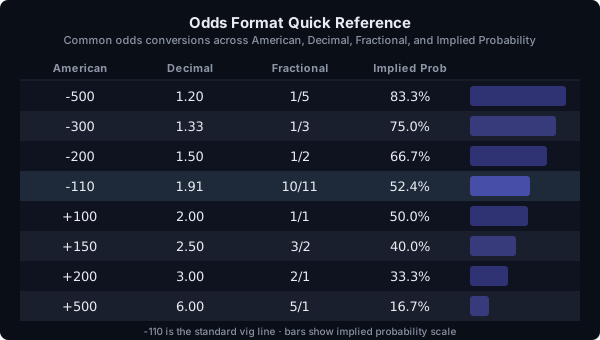
Quick Reference: Common Odds Conversions
| American | Decimal | Fractional | Implied Prob. |
|---|---|---|---|
| -500 | 1.20 | 1/5 | 83.3% |
| -300 | 1.33 | 1/3 | 75.0% |
| -200 | 1.50 | 1/2 | 66.7% |
| -150 | 1.67 | 2/3 | 60.0% |
| -110 | 1.91 | 10/11 | 52.4% |
| +100 | 2.00 | 1/1 | 50.0% |
| +150 | 2.50 | 3/2 | 40.0% |
| +200 | 3.00 | 2/1 | 33.3% |
| +300 | 4.00 | 3/1 | 25.0% |
| +500 | 6.00 | 5/1 | 16.7% |
Common Questions
How do I convert -110 to decimal?
Divide 100 by the absolute value (110), then add 1. So 100/110 + 1 = 1.909. This means you get $1.91 back for every $1 bet.
What are 'even money' odds?
Even money means a 50/50 proposition. It's +100 in American, 2.00 in Decimal, 1/1 in Fractional, and 50% Implied Probability.
Why do implied probabilities add up to more than 100%?
Because bookmakers build in a profit margin (called the vig or juice). For example, a coin flip market might be priced at -110 on both sides. That's 52.4% + 52.4% = 104.8%. The extra 4.8% is the book's edge.
How do I convert American odds to decimal?
For negative American odds: divide 100 by the absolute value, then add 1. Example: -150 → 100/150 + 1 = 1.667. For positive American odds: divide the odds by 100, then add 1. Example: +200 → 200/100 + 1 = 3.00.
How do I convert odds to implied probability?
For negative American odds: divide the absolute value by (absolute value + 100). Example: -200 → 200/300 = 66.7%. For positive odds: divide 100 by (odds + 100). Example: +150 → 100/250 = 40%. Remember, these implied probabilities include the vig, so the true probability is lower.
Which odds format is best?
Decimal odds are the easiest to work with mathematically. Multiply your stake by the decimal to get your total return. American odds are standard in the US. Fractional odds are traditional in UK horse racing. For calculating EV and probability, decimal or implied probability are the most intuitive.
How do I read prediction market prices as odds?
A prediction market contract priced at $0.65 implies a 65% probability. To convert to American odds: if the price is above $0.50, use -(price / (1 - price)) × 100. So $0.65 becomes -186. If below $0.50, use ((1 - price) / price) × 100. A $0.30 contract is +233. Decimal odds are simply 1 / price: $0.65 = 1.538 decimal.
What are moneyline odds?
Moneyline odds are American odds applied to a straight win/loss market (no point spread). A -150 moneyline favorite means you risk $150 to win $100. A +130 underdog means you risk $100 to win $130. The moneyline reflects the implied probability of each side winning outright.