
Prediction Market Converter
Convert between sportsbook odds and prediction market prices. See how -163 American translates to a 62¢ contract on Polymarket or Kalshi.
Convert Odds
Sportsbook odds
Prediction market price
Yes
Price: 62.0¢
Profit: 0.38 / share
No
Price: 38.0¢
Profit: 0.62 / share
Payout is always $1.00 per winning share
How Prediction Market Prices Work
Prediction markets like Polymarket and Kalshi let you buy contracts that pay out $1.00 if an event happens. The price of a contract is its implied probability. A “Yes” contract at 62¢ means the market thinks there's a 62% chance the event happens. If you buy it and you're right, you get $1.00 back, a profit of 38¢ per share.
Sportsbook Odds vs. Prediction Market Prices
Sportsbook odds and prediction market prices express the same thing (implied probability) just in different formats. A -163 American moneyline is the same as a 62¢ prediction market contract. The difference is that sportsbooks bake their profit margin (the vig) into both sides, while prediction market prices are set by traders and can be closer to true fair value. To strip the vig from sportsbook odds before comparing, use our De-Vig Calculator.
Yes and No Contracts
Every prediction market event has two sides: Yes and No. Their prices always add up to about $1.00. If Yes is priced at 62¢, No is priced at 38¢. You can bet either direction. Buying “No” at 38¢ is the same as betting against the event. If it doesn't happen, you profit 62¢ per share.
Worked Example
You see the Lakers moneyline at -180 on a sportsbook. How does that compare to Polymarket? Converting: -180 American → implied probability = 180 / (180 + 100) = 64.3%. On a prediction market, that's roughly a 64¢ Yes contract. Going the other direction: a 35¢ contract on Kalshi converts to +186 American odds (100 / 0.35 - 100 = +186) or 2.86 decimal. If you're used to sportsbook odds, a 35¢ contract is a clear underdog. You'd need the event to happen about 1 in 3 times for it to be a fair price.
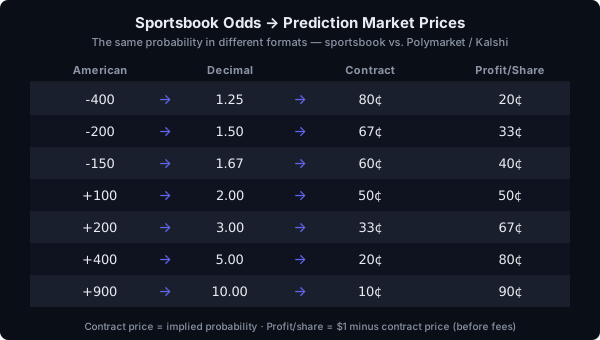
Quick Reference
| American | Decimal | Market Price | Probability |
|---|---|---|---|
| -400 | 1.25 | 80¢ | 80% |
| -200 | 1.50 | 67¢ | 66.7% |
| -150 | 1.67 | 60¢ | 60% |
| +100 | 2.00 | 50¢ | 50% |
| +200 | 3.00 | 33¢ | 33.3% |
| +400 | 5.00 | 20¢ | 20% |
| +900 | 10.00 | 10¢ | 10% |
Common Questions
Why don't sportsbook odds convert to exactly round prediction market prices?
Sportsbook odds include the vig (profit margin), so both sides add up to more than 100%. Prediction market prices on fair markets add up to exactly 100% ($1.00). This converter shows the raw implied probability. To compare properly, you'd want to de-vig the sportsbook odds first using our De-Vig Calculator.
Do Polymarket and Kalshi price things the same way?
Yes. Both use cent-based pricing where contracts pay $1.00 if correct. A 62¢ contract on Polymarket means the same thing as a 62¢ contract on Kalshi. The difference is in their fee structures, which you can compare using our Fee Calculator.
Can I use this for any prediction market?
Yes. Any market that uses $1.00-payout binary contracts works the same way. This includes Polymarket, Kalshi, PredictIt, Metaculus, and others.
Why would I need to convert between formats?
If you bet sports and also trade prediction markets, you're used to thinking in American odds (-150, +200). Prediction markets display prices in cents. Converting lets you apply your sports betting intuition (like knowing that -200 is a strong favorite) directly to prediction market prices (67¢ contract). It also helps when comparing odds across both types of platforms.
How do prediction market prices relate to probability?
On a fair prediction market, the contract price IS the implied probability. A 65¢ contract implies a 65% chance. This is simpler than sportsbook odds where you need to calculate implied probability from the vig-adjusted line. However, prediction market prices can also include margin. If Yes + No prices sum to more than $1.00, there's overround just like in sportsbooks.