
Parlay True Odds Calculator
Enter each leg's market odds to find the true fair probability of your parlay and see how much vig the book is charging.
Parlay True Odds
Parlay legs
Add other side to de-vig
Book's parlay odds
optional
True probability: 27.44%
Why Parlay Vig Is Worse Than You Think
Every sportsbook line has vig (the book's profit margin) baked in. On a single bet, that vig might be 4-5%. But when you combine legs into a parlay, the vig doesn't just add up. It compounds multiplicatively. Each leg's inflated probability gets multiplied together, meaning the total overround on a parlay is significantly larger than the sum of each leg's vig. That's why sportsbooks love parlays, and why you need to know the true fair odds before placing one.
How This Calculator Works
- Enter both sides of each parlay leg (e.g., Chiefs -160 / 49ers +140)
- The tool de-vigs each leg to find the true fair probability for your pick
- Multiplies the fair probabilities across all legs to get the true parlay probability
- Optionally enter the book's parlay odds to see your EV, whether the book is offering better or worse than fair
The Compounding Vig Problem
Consider a simple example: each leg of your parlay is priced at -110/-110. A single -110/-110 line has roughly 4.5% overround. You might think a 3-leg parlay would have about 3 × 4.5% = 13.5% total vig. But it's actually worse. When you multiply the vigged implied probabilities together, the effective overround on the parlay is even higher than the sum of the individual legs. The more legs you add, the more the vig compounds against you. This calculator strips out the vig from each leg first, so you can see exactly how much the book is overcharging on the full parlay.
Worked Example
You want to parlay three NFL sides, all priced at -110/-110. The book's implied probability for each pick is 52.4%. Your 3-leg parlay probability using the book's juiced odds: 0.524 × 0.524 × 0.524 = 14.4%. But the true fair probability of each leg (after de-vigging with Power method) is 50%. True parlay probability: 0.50 × 0.50 × 0.50 = 12.5%. The book is implying 14.4% while the true fair odds are 12.5%. That's a 1.9% gap, which is the compounded vig. If the book pays out at +596 (the standard -110 parlay payout), you're paying a 13% effective overround on the full parlay compared to fair odds.
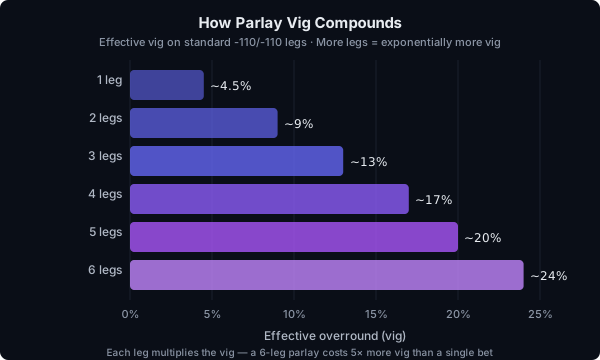
Standard Parlay Payouts (-110 per leg)
| Legs | True Fair Odds | Typical Book Payout | Effective Vig |
|---|---|---|---|
| 2 | +300 | +264 | ~9% |
| 3 | +700 | +596 | ~13% |
| 4 | +1500 | +1228 | ~17% |
| 5 | +3100 | +2435 | ~20% |
| 6 | +6300 | +4741 | ~24% |
The pattern is stark: a 2-leg parlay costs you about 9% in vig, but by 6 legs you're paying nearly 24%. Every additional leg makes the parlay significantly worse for the bettor. This is why sportsbooks aggressively promote parlays. They're among the highest-margin products in the industry.
Common Questions
Why are parlays bad for bettors?
The vig compounds across every leg. Each leg's overround gets multiplied together, so the book's total edge on a parlay is much larger than on any single bet. On top of that, many books add an additional 'parlay tax,' paying out at worse odds than the true multiplicative payout.
Are all parlays -EV?
Not necessarily. If each individual leg is +EV (the true fair probability is higher than what the line implies), then the parlay can be +EV too. But the compounding vig makes it much harder. You need a genuine edge on every leg, not just one or two.
Should I ever bet parlays?
Only if you have a genuine edge on each leg. Correlated parlays (where the outcomes are related) can sometimes offer value that the book hasn't fully priced in. But random multi-leg parlays at standard odds are the sportsbook's best friend. The compounding vig virtually guarantees a large house edge.
What if I don't know both sides of a leg?
You need both sides to de-vig a market. Without the other side's odds, there's no way to calculate how much vig is built in. Try checking an odds comparison site like OddsJam, OddsBoom, or the sportsbook directly to find the opposing side's line.
Which de-vig method should I use?
Start with Power. It's the most accurate for most two-outcome markets. It accounts for the fact that books tend to overcharge underdogs more than favorites. If you want a conservative estimate, check the Worst Case row in the Compare All Methods section.
How do you calculate parlay odds?
Convert each leg to decimal odds and multiply them together. Example: a 2-leg parlay with -110 (1.909) and +150 (2.50) → 1.909 × 2.50 = 4.773 decimal, or about +377 American. But this is the book's payout. The TRUE fair odds require de-vigging each leg first, which is what this calculator does.
What does a 3-team parlay pay?
It depends entirely on the odds of each leg. Three legs at -110 each would pay roughly +596 (6.96 decimal). Three legs at +100 each would pay +700 (8.00 decimal). The actual payout depends on the specific odds and how the book handles parlay pricing. Some books use true multiplicative odds, others use a parlay card with fixed payouts.
What are correlated parlays?
Correlated parlays combine outcomes that are statistically related. For example, parlaying a team's moneyline with the game going over the total. If a team wins, they likely scored a lot, making the over more likely too. Books try to block or limit correlated parlays because they can offer genuine value to sharp bettors.