
Multi-Outcome Market Calculator
Enter prices for all outcomes in a multi-outcome market. See the overround, fair probabilities from de-vig analysis, and which outcomes are most mispriced.
Multi-Outcome Market
De-vig method
Market prices sum to 105.0¢ instead of 100¢
Multi-Outcome Markets
Multi-outcome markets (like “Who wins the nomination?” or “What range will GDP fall in?”) have prices that sum to more than $1.00. The excess is the overround (the market's margin). This tool strips that margin away to show you the true fair probabilities, so you can see which outcomes are overpriced and which are underpriced.
Finding Mispriced Outcomes
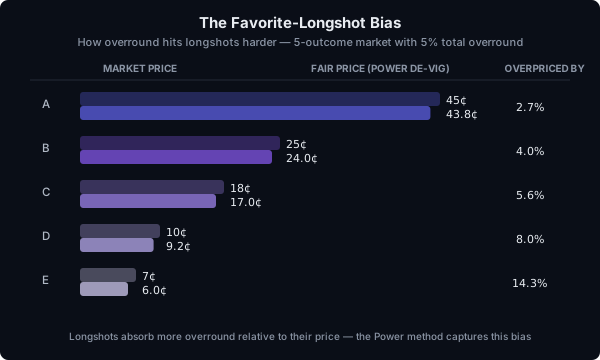
Multi-outcome markets are where the biggest mispricings hide. In a 2-way market, the vig is easy to see and arbitrage keeps prices efficient. But when there are 5, 8, or 12 outcomes, the overround gets distributed unevenly, and that unevenness creates opportunity. Longshot outcomes tend to absorb more of the margin (the favorite-longshot bias), which means favorites are often closer to fair value while longshots are systematically overpriced.
How to Use This Calculator
- Enter the current market price for each outcome in cents (e.g., 40¢, 25¢, 20¢, 15¢)
- Add or remove outcomes as needed (supports 3 to 12)
- The calculator shows the total overround and each outcome's de-vigged fair probability
- Compare the fair probability to the market price. Positive edge means underpriced, negative means overpriced
Worked Example
A “Who wins the GOP primary?” market on Polymarket has 5 candidates: A at 45¢, B at 25¢, C at 18¢, D at 10¢, and E at 7¢. Total: 105¢, a 5% overround. Using the Power de-vig method, candidate A's fair probability is 43.8% (vs. 45¢ market price = overpriced by 2.7%), while candidate D's fair probability is 9.2% (vs. 10¢ market price = overpriced by 8.0%). Notice how the longshot E at 7¢ is overpriced by 14.3%, far more than the favorite. If your analysis says candidate C actually has a 22% chance but the fair price is only 17.0%, that's a 5% edge worth exploring. Size your position using the Prediction Market EV Calculator to see your expected profit after fees.
Common Questions
Why do prices sum to more than $1.00?
Markets build in a margin (overround). If 3 outcomes trade at 40c, 35c, and 30c, they sum to 105c. The extra 5c is the market's edge. Every outcome is slightly overpriced. De-vigging removes this to find true fair values.
Which de-vig method should I use?
Power is the best default. It accounts for the fact that longshots tend to be overpriced more than favorites. Shin is also good for competitive markets. Multiplicative is simplest but treats all outcomes equally.
What does a positive edge mean?
A positive edge means the de-vigged fair probability is higher than the market price, so the outcome is underpriced. This is where you'd want to buy. A negative edge means the market is overpricing that outcome.
Why are longshots usually overpriced?
This is called the favorite-longshot bias. In both sportsbooks and prediction markets, low-probability outcomes tend to be overpriced relative to their true odds. Bettors are drawn to high payoffs, creating extra demand for longshots. The Power de-vig method specifically accounts for this by assigning more of the overround to longshot outcomes.
How many outcomes can I analyze?
This calculator supports 3 to 12 outcomes. It works for any multi-outcome market: political primaries (who wins the nomination), economic brackets (what range will GDP fall in), sports futures (which team wins the division), or any prediction market with multiple mutually exclusive outcomes.