
What's My Edge?
Enter your betting record and average odds to find out if your results reflect genuine skill or just good variance.
What's My Edge?
Possibly Lucky
87% confident
but not conclusive yet
You need ~214 more bets at this rate for 95% confidence
Am I Good or Just Lucky?
Every sports bettor who starts winning asks the same question: is this skill, or am I just running hot? It's one of the hardest questions in betting because variance can masquerade as edge for hundreds of bets. A 55% win rate over 100 bets at -110 looks great, but it could easily be explained by normal randomness. This calculator applies the same statistical framework used in academic research and professional betting to answer that question with math, not gut feeling.
How This Calculator Works
The calculator uses a one-sided z-test. It starts by computing the breakeven win rate from your average odds. That's the win rate you'd need just to break even. Then it measures how far above breakeven your actual win rate is and compares that gap to how much random noise you'd expect from the number of bets you've placed. If your win rate is far enough above breakeven relative to the expected noise, the calculator concludes your results are unlikely to be explained by luck alone.
Understanding Your Results
Confidence % tells you how likely it is that your edge is real and not random noise. At 95% or higher, statisticians consider the result “statistically significant.” Estimated edge is the gap between your observed win rate and the breakeven win rate. ROI shows your return on investment as a percentage of total dollars wagered. 95% CI for win rate is a confidence interval . There's a 95% chance your true long-run win rate falls within this range. If the lower end of the CI is above breakeven, that's a strong signal. Bets needed tells you how many more bets at your current rate you'd need to reach 95% confidence.
Worked Example
You've bet 200 games at average odds of -110, going 112-88 (56% win rate). The breakeven win rate at -110 is 52.4%. Your observed edge is 56% - 52.4% = 3.6%. Is that real? The z-score comes out to 1.02, which translates to about 85% confidence. That's promising but well short of statistically significant at the standard 95% threshold. The calculator would tell you that you need roughly 320 more bets at the same rate to cross the 95% line. At 56% win rate, your ROI is about 6.9%, meaning you profit $6.90 for every $100 wagered.
Why Sample Size Matters
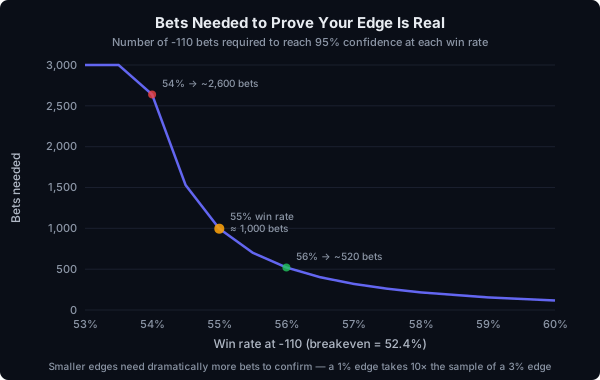
Sports betting has enormous variance. A 55% bettor can easily go 48-52 over 100 bets and look like a loser, or 58-42 and look like a genius. Neither conclusion would be statistically valid. The smaller your edge, the more bets you need to prove it's real. A 5% edge might take 250 bets to confirm. A 2% edge could take 2,000+. This is why tracking your results and using a statistical framework matters. Your gut feeling about your performance is almost certainly wrong in one direction or the other.
Common Questions
How many bets do I need?
It depends entirely on your edge. A bettor with a 5% edge over breakeven might need 250-400 bets. A bettor with a 2% edge might need 2,000+. The smaller the edge, the more bets required to distinguish it from noise. This calculator shows you exactly how many you need.
What's a good confidence level?
95% is the standard threshold for statistical significance in academic research. Above 95% means it's very unlikely your results are due to luck alone. Between 70-95% is promising but not conclusive. Below 70% means you don't have enough data to draw a conclusion yet.
Why 95%?
The 95% threshold (also written as p < 0.05) is a widely adopted convention in statistics. It means there's less than a 5% chance of seeing your results if you had no edge at all. It's not magic. It's just the line the statistics community has agreed on for 'good enough to publish.'
What if my odds vary a lot?
This calculator uses your average odds as a simplification. If you mostly bet at similar odds (e.g., -110 spreads), it's very accurate. If your odds vary widely (mixing heavy favorites with longshots), the result is still directionally useful but should be taken as an approximation. For maximum accuracy, group your bets by odds range and analyze each group separately.
Can I embed this?
Yes. Use the embed code generator below the calculator to get an iframe snippet you can paste into any website, blog, or article. The embed is responsive and works on all screen sizes.
What ROI is realistic for sports betting?
Most successful long-term bettors generate 2-5% ROI on their wagers. Even the sharpest bettors rarely sustain above 7-8% ROI at volume. Claims of 15-20%+ ROI are almost always from small sample sizes or cherry-picked results. Volume matters more than hit rate. A 3% ROI on $500,000 in annual action is $15,000 in profit.
How is betting ROI calculated?
ROI = (Total Profit / Total Amount Wagered) × 100. If you've wagered $10,000 total and your current bankroll is $10,340, your profit is $340 and your ROI is 3.4%. This is the standard measure for comparing betting performance regardless of bankroll size or bet frequency.